

Hey there! As a supplier of scandium nitrate, I often get asked about what happens when this compound is heated. So, I thought I'd take a moment to break it down for you in this blog post.

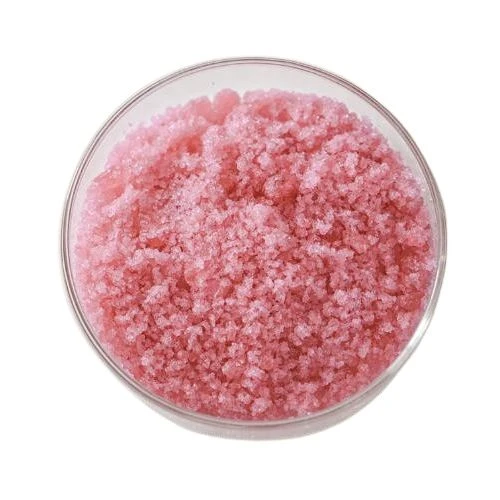
Scandium nitrate, with the chemical formula Sc(NO₃)₃, is a compound that contains scandium, a rare - earth metal, and nitrate ions. When you heat scandium nitrate, a series of chemical reactions occur, leading to the formation of different decomposition products.
Let's start with the basics of thermal decomposition. Thermal decomposition is a chemical reaction where a single compound breaks down into two or more simpler substances when heated. For scandium nitrate, the decomposition process occurs in multiple steps, and the final products depend on the temperature and the heating conditions.
Initial Stages of Decomposition
At relatively low temperatures (around 100 - 200°C), scandium nitrate starts to lose its water of crystallization if it's in a hydrated form. Many commercial scandium nitrate products are hydrated, usually in the form of Sc(NO₃)₃·xH₂O, where x can be 3, 4, or 6. The water molecules are held in the crystal lattice of the compound, and as the temperature rises, they gain enough energy to break free.
The reaction for the loss of water of crystallization can be represented as:
Sc(NO₃)₃·xH₂O(s) → Sc(NO₃)₃(s)+xH₂O(g)
This is a physical change rather than a chemical one in the strictest sense, as the chemical composition of the scandium nitrate part remains the same. You'll notice that the solid scandium nitrate may start to look a bit drier and more powdery as the water evaporates.
Intermediate Decomposition
As the temperature continues to increase, around 200 - 400°C, the nitrate ions in scandium nitrate start to decompose. Nitrate ions (NO₃⁻) are relatively unstable at higher temperatures, and they begin to break down. One of the main products of this decomposition is nitrogen dioxide (NO₂), a reddish - brown gas with a pungent odor.
The reaction can be written as:
2Sc(NO₃)₃(s) → 2ScO(NO₃)(s)+ 4NO₂(g)+O₂(g)
In this step, a part of the nitrate groups in scandium nitrate are converted into nitrogen dioxide and oxygen gas, while the remaining part forms a new compound called scandium oxynitrate (ScO(NO₃)). Scandium oxynitrate is an intermediate product and is still a solid at this stage.
Final Decomposition
When the temperature reaches above 400°C, usually around 500 - 600°C, the scandium oxynitrate further decomposes. The remaining nitrate groups are completely broken down, and the final product is scandium oxide (Sc₂O₃).
The reaction is:
4ScO(NO₃)(s) → 2Sc₂O₃(s)+ 4NO₂(g)+O₂(g)
Scandium oxide is a white solid, and it's a stable compound at high temperatures. It has various applications in industries such as ceramics, electronics, and lighting.
Comparison with Other Rare - Earth Nitrates
It's interesting to compare the decomposition of scandium nitrate with other rare - earth nitrates. For example, Praseodymium Nitrate and Erbium Nitrate also undergo thermal decomposition. However, the decomposition temperatures and products can vary slightly due to the different chemical properties of the rare - earth metals.
Praseodymium nitrate (Pr(NO₃)₃) decomposes in a similar multi - step process. At lower temperatures, it loses water of crystallization, and at higher temperatures, the nitrate groups break down to form nitrogen dioxide, oxygen, and finally praseodymium oxide (Pr₆O₁₁). The oxidation state of praseodymium in its oxide is different from that of scandium in scandium oxide, which shows the unique chemical behavior of each rare - earth element.
Erbium nitrate (Er(NO₃)₃) follows a comparable decomposition pathway. It loses water first, then the nitrate groups decompose to produce nitrogen dioxide and oxygen, and the final product is erbium oxide (Er₂O₃). The difference in the decomposition kinetics might be due to factors such as the size of the erbium ion and its electronic configuration.
Another related compound is Neodymium Nitrate. Neodymium nitrate (Nd(NO₃)₃) also decomposes to form nitrogen dioxide, oxygen, and neodymium oxide (Nd₂O₃) upon heating. The study of these different rare - earth nitrates helps in understanding the general trends and specific characteristics of rare - earth compounds during thermal decomposition.
Practical Implications
Understanding the decomposition products of scandium nitrate is crucial for several reasons. In industrial processes, if you're using scandium nitrate as a precursor for making scandium - based materials, such as scandium oxide for high - performance ceramics or catalysts, you need to control the heating conditions carefully. Incorrect heating can lead to incomplete decomposition or the formation of unwanted by - products.
In the laboratory, when working with scandium nitrate, safety precautions must be taken. The nitrogen dioxide gas produced during decomposition is toxic and can cause respiratory problems. Adequate ventilation is necessary to ensure that the gas is safely removed from the working area.
Conclusion
So, to sum it up, when you heat scandium nitrate, you first lose the water of crystallization at lower temperatures. As the temperature rises, the nitrate groups decompose, producing nitrogen dioxide and oxygen gas, and the final product is scandium oxide. This decomposition process is similar to that of other rare - earth nitrates, but with some unique features due to the properties of scandium.
If you're interested in purchasing scandium nitrate for your research or industrial applications, don't hesitate to reach out. We're here to provide you with high - quality scandium nitrate and answer any further questions you might have about its properties and uses. Whether you're a scientist looking to conduct experiments or an industry professional in need of raw materials, we can offer the right product for you.
References
- Cotton, F. A.; Wilkinson, G.; Murillo, C. A.; Bochmann, M. Advanced Inorganic Chemistry. John Wiley & Sons, 1999.
- Greenwood, N. N.; Earnshaw, A. Chemistry of the Elements. Butterworth - Heinemann, 1997.