

Hey there! As a supplier of thulium nitrate, I often get asked about how this rare earth compound reacts with phosphorus - containing compounds. Today, I'm gonna dig deep into this topic and share with you all the cool science behind it.
First off, let's talk a bit about thulium nitrate. Thulium is a rare earth element, and its nitrate form, thulium nitrate, is a water - soluble salt. It's got some pretty interesting properties and applications in various fields, like in catalysts, lasers, and even in some research on magnetic materials.
Now, when it comes to reacting with phosphorus - containing compounds, things can get a bit complex, but also really fascinating. Phosphorus - containing compounds are a diverse group. They can range from simple inorganic phosphates to complex organic phosphines.
Reaction with Inorganic Phosphates
Let's start with inorganic phosphates, like sodium phosphate (Na₃PO₄). When thulium nitrate (Tm(NO₃)₃) comes into contact with sodium phosphate in an aqueous solution, a precipitation reaction can occur. The nitrate ions from thulium nitrate and the sodium ions from sodium phosphate remain in solution as spectator ions, while the thulium ions (Tm³⁺) react with the phosphate ions (PO₄³⁻) to form thulium phosphate (TmPO₄).
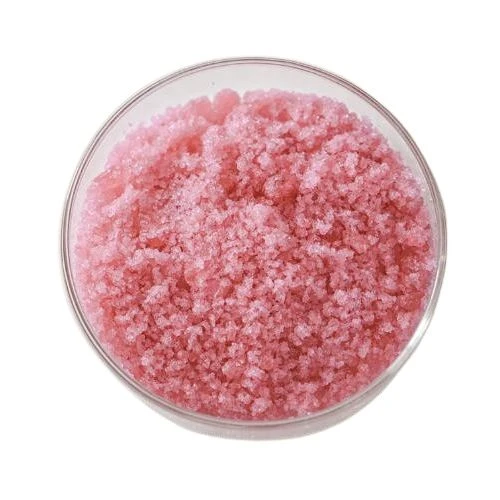

The chemical equation for this reaction is:
3Na₃PO₄(aq) + Tm(NO₃)₃(aq) → TmPO₄(s) + 9NaNO₃(aq)
Thulium phosphate is a sparingly soluble compound, so it will precipitate out of the solution as a solid. This precipitation reaction is quite useful in some separation and purification processes. For example, if you want to isolate thulium from a mixture of rare earth elements, reacting it with a phosphate compound can help you selectively precipitate thulium phosphate.
Reaction with Organic Phosphines
On the other hand, when thulium nitrate reacts with organic phosphines, the story is a bit different. Organic phosphines have a phosphorus atom bonded to organic groups. They are often used as ligands in coordination chemistry.
When thulium nitrate reacts with certain organic phosphines, a coordination complex can form. The phosphorus atom in the phosphine has a lone pair of electrons, which can be donated to the thulium ion. This forms a coordinate covalent bond between the phosphine ligand and the thulium ion.
The resulting coordination complex can have some unique properties. For example, it might have different solubility, color, or magnetic properties compared to the original thulium nitrate. These complexes can also be used in catalysis. The thulium - phosphine complex can act as a catalyst for certain organic reactions, like the activation of small molecules or the synthesis of complex organic compounds.
Factors Affecting the Reaction
There are several factors that can affect how thulium nitrate reacts with phosphorus - containing compounds. One of the most important factors is the reaction conditions, such as temperature, pH, and concentration.
- Temperature: Generally, increasing the temperature can speed up the reaction rate. For the precipitation reaction between thulium nitrate and inorganic phosphates, a higher temperature can help the ions move around more freely, increasing the chances of collision and reaction. However, for some coordination complex formation reactions, too high a temperature might break the coordinate bonds and disrupt the complex.
- pH: The pH of the solution can also have a big impact. In the case of the precipitation reaction with inorganic phosphates, the solubility of thulium phosphate is pH - dependent. At a certain pH range, thulium phosphate will be more likely to precipitate. For reactions with organic phosphines, the pH can affect the protonation state of the phosphine ligand, which in turn can affect its ability to form a coordination complex with thulium.
- Concentration: The concentration of thulium nitrate and the phosphorus - containing compound also matters. If the concentration of the reactants is too low, the reaction might be very slow or might not occur at all. On the other hand, if the concentration is too high, side reactions or the formation of unwanted by - products might occur.
Applications of the Reactions
The reactions between thulium nitrate and phosphorus - containing compounds have a wide range of applications.
- Materials Science: The precipitation of thulium phosphate can be used to synthesize thulium - based ceramic materials. These materials can have interesting optical and electrical properties, which make them useful in applications like optoelectronics and sensors.
- Catalysis: As mentioned earlier, the coordination complexes formed between thulium nitrate and organic phosphines can be used as catalysts. They can help speed up chemical reactions, reduce the energy required for the reaction, and increase the selectivity of the reaction.
- Analytical Chemistry: The precipitation reaction can also be used in analytical chemistry to determine the concentration of thulium in a sample. By adding a known amount of a phosphate compound and measuring the amount of thulium phosphate precipitate formed, you can calculate the amount of thulium in the original sample.
Other Related Compounds
If you're interested in rare earth nitrates, you might also want to check out some other compounds like Erbium Nitrate, Gadolinium Nitrate, and Holmium Nitrate. These compounds also have their own unique properties and reactions, and they can be used in a variety of applications similar to thulium nitrate.
Conclusion
In conclusion, the reactions between thulium nitrate and phosphorus - containing compounds are really diverse and interesting. Whether it's the precipitation reaction with inorganic phosphates or the formation of coordination complexes with organic phosphines, these reactions have important applications in many fields.
If you're in the market for high - quality thulium nitrate or have any questions about its reactions with phosphorus - containing compounds, don't hesitate to reach out. We're here to provide you with the best products and technical support.
References
- Cotton, F. A.; Wilkinson, G.; Murillo, C. A.; Bochmann, M. (1999). Advanced Inorganic Chemistry (6th ed.). Wiley - Interscience.
- Housecroft, C. E.; Sharpe, A. G. (2004). Inorganic Chemistry (2nd ed.). Pearson Prentice Hall.